Structure new commercial dispute enquiries for review
A shareholder dispute over a dividend, an unpaid invoice from a major customer, the end of a long-standing supply agreement: the director writes late in the evening, between two meetings, or from a phone on a Sunday. Lorne & Vale captures the enquiry, structures it into an inquiry brief and puts it on the right lawyer’s desk, with a response target. You keep the decision.
Shareholder dispute, dividend withheldHello, I hold 40% of Example Studio SAS, a company I co-founded. The board has again recommended no dividend, for the third year running, and I am no longer being sent the accounts. I need to speak to a lawyer quickly.
Direct email · Thursday eveningThe office is closed
Fictional person and company, address reserved for examples.
Received
Structured
Routed
Acknowledged
On the iPhone
Web platform view and iPhone app screenshots. All demo data is fictional.
A week in a commercial litigation firm
Three situations you will recognise
Every enquiry arrives with an inquiry brief: summary, urgency, parties to check, missing information, documents to request. Here is what it would surface.
A shareholder dispute over dividends
Fictional example: “I own 40% of the company I co-founded. Profits have been retained for the third year in a row and I no longer receive the accounts.”
Information to prepare for review
Human review
The lawyer checks the situation, urgency and applicable time limits.
Parties to check
The shareholder, company, president and other shareholders.
Missing information
Ownership structure, meeting date, shareholders’ agreement and any statutory auditor.
Documents to discuss
Current articles, shareholders’ agreement, recent meeting minutes and approved accounts.
Unpaid invoices from a major customer
Fictional example: “This customer represents almost a quarter of our turnover. Three invoices have been unpaid since May and they no longer answer our reminders.”
Information to prepare for review
Human review
The lawyer checks the situation, urgency and applicable time limits.
Parties to check
The business making the inquiry, the customer and its parent company.
Missing information
Principal amount and due dates, formal demands already sent and any insolvency proceedings.
Documents to discuss
Contract and sales terms, orders, delivery records, invoices and reminders.
An eight-year commercial relationship ending
Fictional example: “Our main customer wrote on Friday to say everything stops at the end of the month. We have worked with them for eight years.”
Information to prepare for review
Human review
The lawyer checks the situation, urgency and applicable time limits.
Parties to check
The business making the inquiry, the customer and its group companies.
Missing information
Relationship duration and volume, share of turnover, stated notice period and any framework contract.
Documents to discuss
Framework agreement and amendments, recent orders and invoices, termination letter and preceding correspondence.
Illustrative examples, fictional people and companies. What a brief contains depends on the enquiry received. The brief summarises, scores and flags; it does not advise and it decides nothing. Someone at the firm assesses the merits and replies.
Demonstration
A demonstration on a fictional enquiry
The screens below are the product’s own, on the demonstration firm’s enquiry: Charlotte Bennett, a fictional person, writes at 22:47 about a family matter. The grid is the same for a shareholder dispute or an unpaid invoice: the same fields, the same response target, the same human review before any decision.
The enquiry brief
What the lawyer reads before deciding
The same grid at 2 pm and at 11 pm. Nothing is decided in their place.
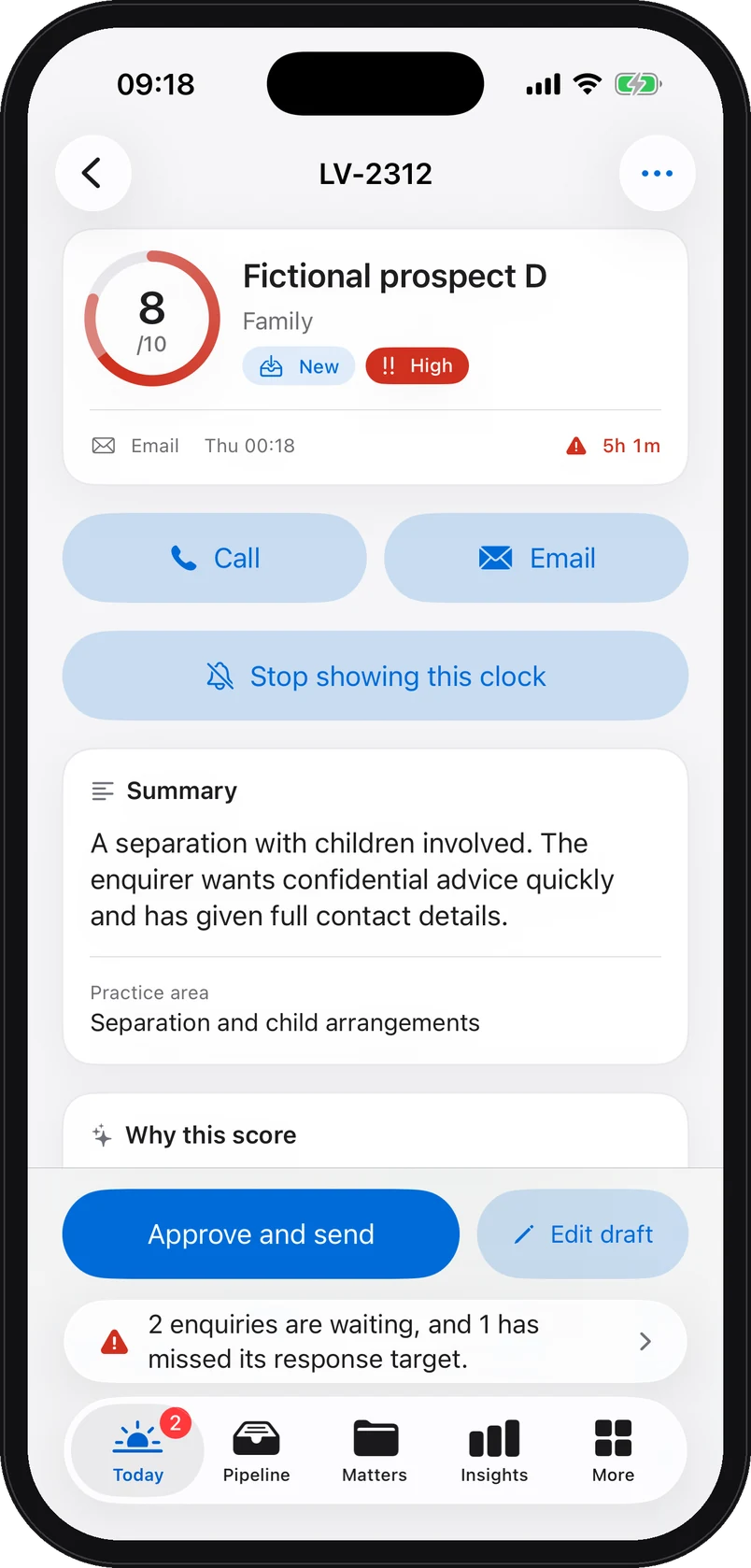
Score out of 10, qualification level and priority, with the rationale in plain words. On screen: 8 out of 10, hot, priority P1. On an unpaid invoice the rationale cites what the enquiry contains: the sum mentioned, how long the debt has run, the documents referred to.
Practice area, routing and next step. On screen, family law. In your firm the practice area would be commercial litigation, with a suggested first contact: the partner who handles shareholder disputes, or the one who handles debt recovery.
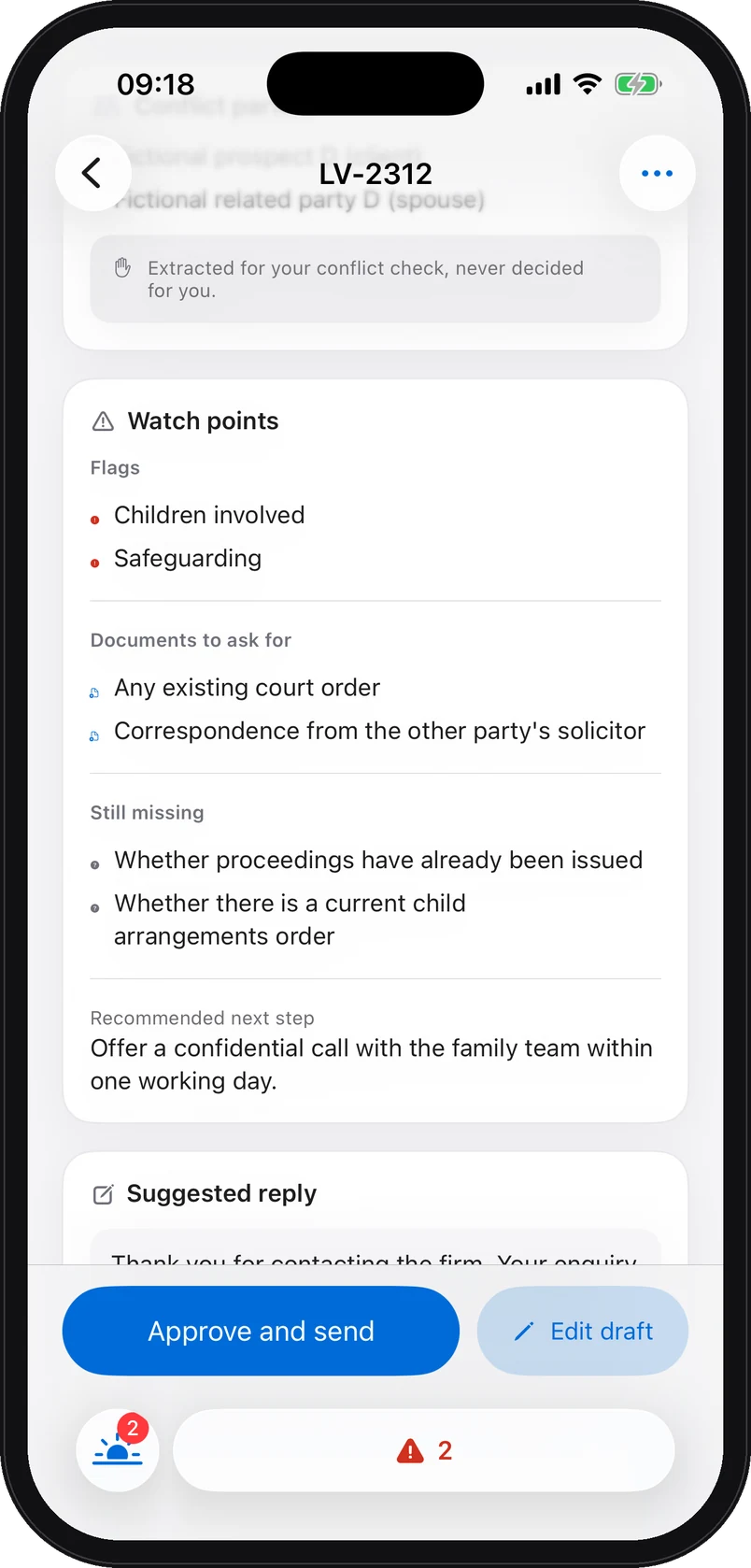
Needs attention. The watch points of the enquiry. On a commercial matter these are the dates to verify: the date of the resolution in question, the end of the notice given, whether an insolvency process has been started against the debtor.
Missing information and documents to request. In commercial litigation: the supply agreement and its variations, the board and general meeting minutes, the invoices and the chasing correspondence, the termination letter.
Counterparties and conflict check. The companies and people named in the enquiry are extracted and set out for your own search: the debtor and its group, the other shareholders, the customer. The extraction comes from the model and requires human verification.
The brief uses the vocabulary of the enquiry: general meeting, shareholders’ agreement, formal demand for payment, notice period. It records the dates to verify, without characterising the dispute or indicating a procedure. The person’s identifiers are replaced by tokens before any model call. Names are restored only inside your firm’s database.
Overview›Enquiries›DetailSearch name, email, company+ New enquiry
AI triageHighP1
8/10
Going through a separation with two children involved. Wants confidential advice quickly and left full contact details.
Practice areaFamily · Separation and arrangements for the children
Suggested first contactPartner, Family team
Recommended next stepOffer a confidential call with the Family team within one working day.
Score rationaleClearly described situation, children involved, explicit request for quick advice and full contact details. Merits and acceptance remain for a lawyer to assess.
Intake quality 8/10Analysed 1 Sept 2026, 23:47
Needs attention
Children involvedSafeguarding
Missing informationWhether proceedings have already been issuedWhether an order on arrangements is in force
Documents to requestAny existing court orderLetters from the other party’s lawyer
On the iPhone
The same brief, in the partner’s pocket
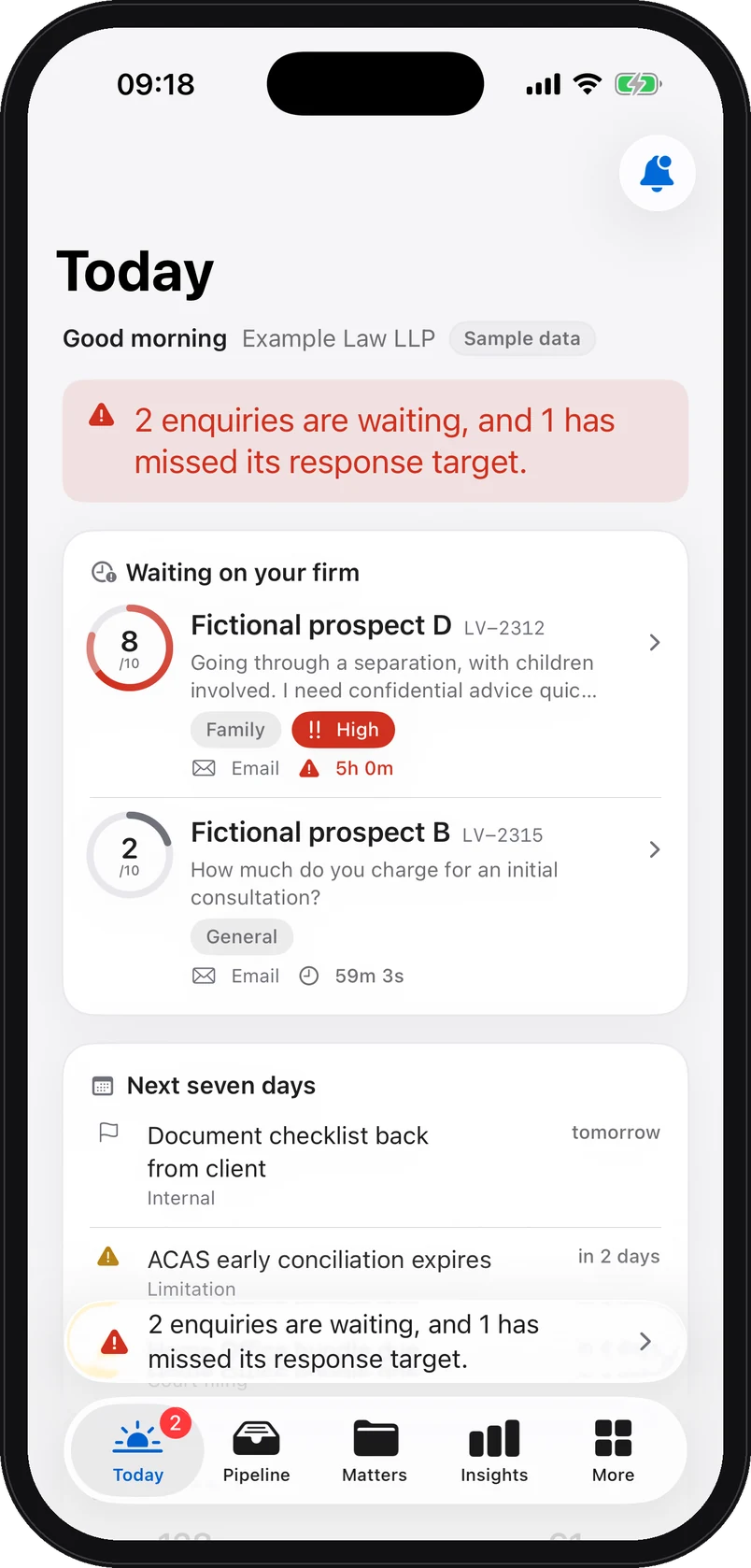
What is waiting, with its countdown. A suggested reply, marked as a draft. Two buttons: Approve and send, Edit draft.
A countdown on the lock screen, if the partner asks for it, and a reminder half an hour before the response target runs out. The reminder names a practice area and a score, never a client.
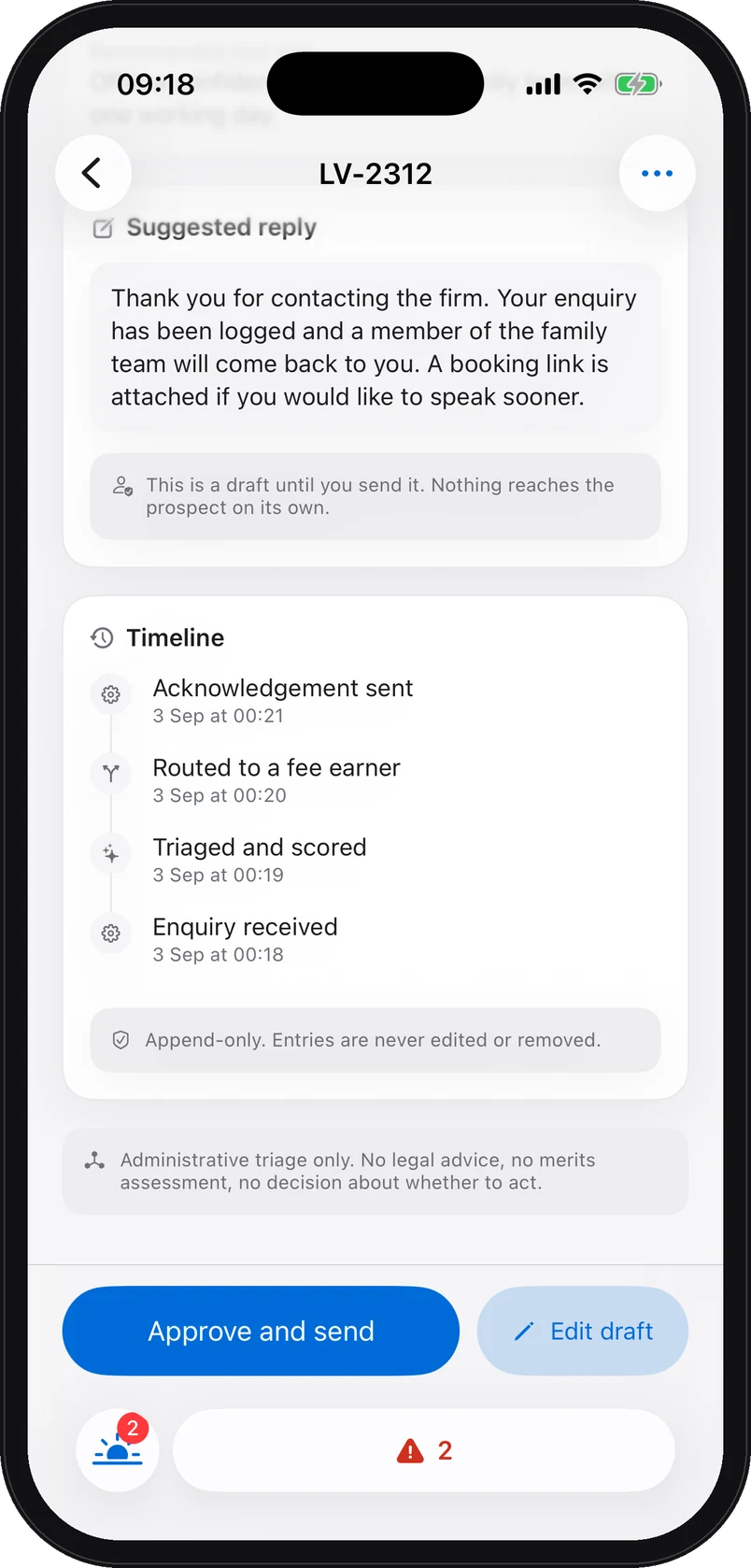
Draft replies for review The suggested reply only goes out if a lawyer approves or edits it. The only thing that leaves on its own is the acknowledgement, in wording approved at setup.
An append-only history: received, triaged and scored, routed to a fee earner, acknowledgement sent. Corrections add a new entry. Retention and deletion follow the applicable schedule.
Face ID locks the app as soon as it goes to the background.
Web platform view and iPhone app screenshots. All demo data is fictional.
Your figures
Compare fees and subscription costs
An illustrative calculation using the assumptions published for France.
These are assumptions, not measured results or a forecast of new matters. Replace them with your own figures. Setup fees, delivery costs and collection are excluded. Gross fees are not profit.
Before deciding
Use your own intake records
Review inquiries received, first-response times, follow-up owners and missing information. The pilot scope should address an observed need in your firm.
Four controls you can verify, described without superlatives.
Pseudonymisation before model calls
Names, emails, phone numbers and other identifiers are replaced by tokens before an enquiry reaches a model. Encryption of the mapping depends on the deployment, as described on the security page.
Isolated per firm
Every client-data table carries a per-firm access rule, checked by automated tests on every change.
Documents sealed in the browser
Every document is encrypted before upload under two key exchanges, X25519 and ML-KEM-1024. Uploads are bounded, type-checked and content-inspected: embedded programs are refused.
Chained, signed audit trail
Sensitive actions are hash-linked and the head of the chain is signed daily with ML-DSA-87. The iPhone app verifies the signature on the device.
What we do not claim: no SOC 2 or ISO 27001 certification, and no external penetration test to date. Hosting on Supabase (EU, Ireland) and Vercel; the model is called through a server-side proxy, with no training on your data under OpenAI’s default policy.
Commercial litigation is the included practice area. An additional area costs €295 per month. No per-user or per-inquiry charge. Setup costs €2,950 for Cabinet and Structure, or €3,950 for Association, including €600 at signature. The balance follows the No-Miss Guarantee terms. All prices exclude VAT.
Live in 7 days, a 60-day pilot then month to month, cancel any time, export your data any time. Read the guarantee in full.
Intake audit 15 minutes
See what this would change in your firm
Fifteen minutes with a founder. Your channels, your volume, your commercial litigation enquiries. You leave with a costed estimate and a clear answer, including if it is not for you.