Criminal law Intake

Route criminal enquiries for prompt human review

A relative in police custody, a hearing at the tribunal correctionnel or a complaint following an assault: each first contact needs the right information. Lorne & Vale prepares a brief for your firm. A lawyer assesses urgency and decides how to respond.

  • Human review on everything
  • No legal advice
  • Live in 7 days
  • Isolated per firm
Harry Lawsonharry.lawson@example.invalid
Summons to the tribunal correctionnelHello, I have received a summons to the tribunal correctionnel. The hearing is in three weeks and I have not spoken to a lawyer yet. Please call me back.
Direct email · a weekday eveningThe office is closed
Fictional person, address reserved for examples.
  1. Received
  2. Structured
  3. Routed
  4. Acknowledged
  5. On the iPhone
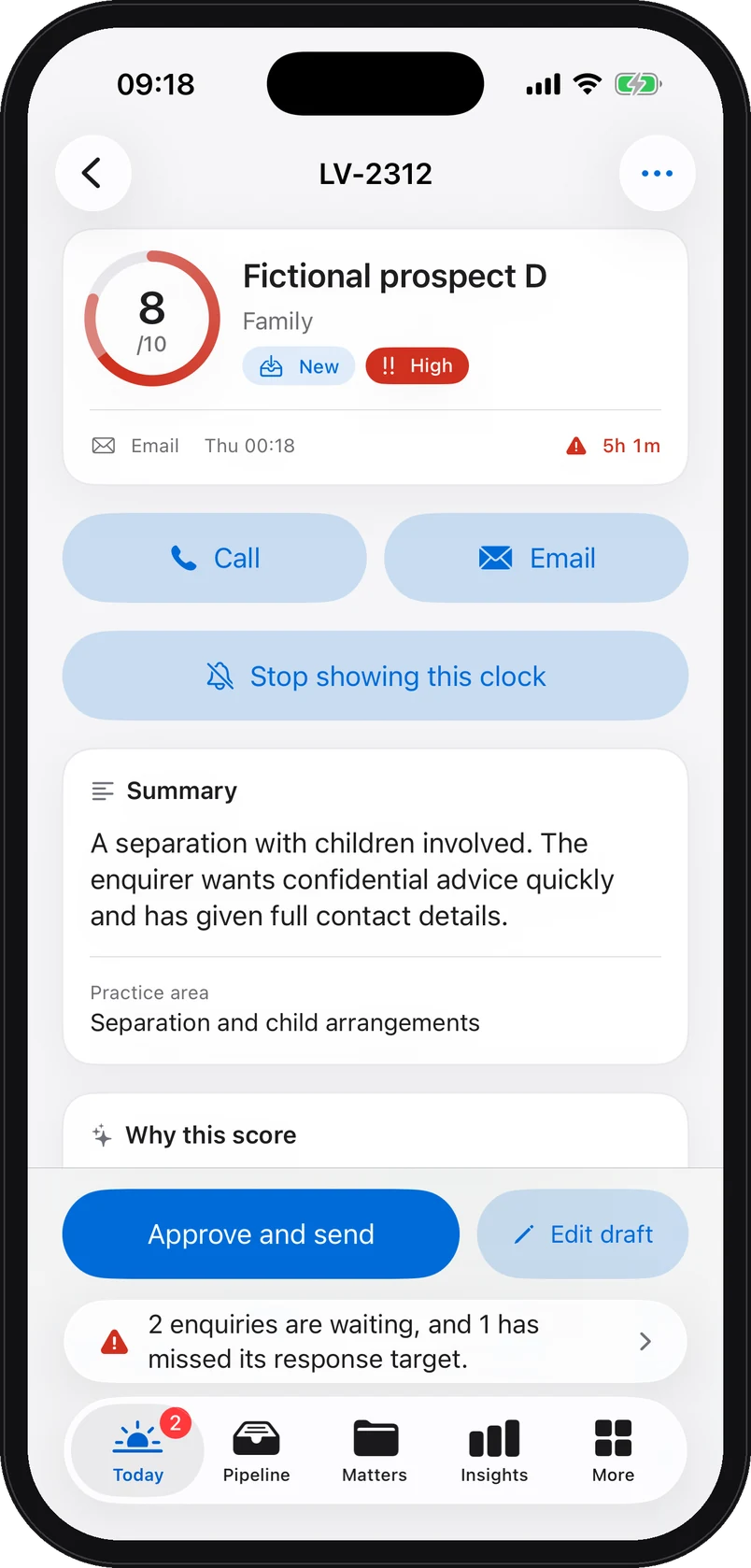
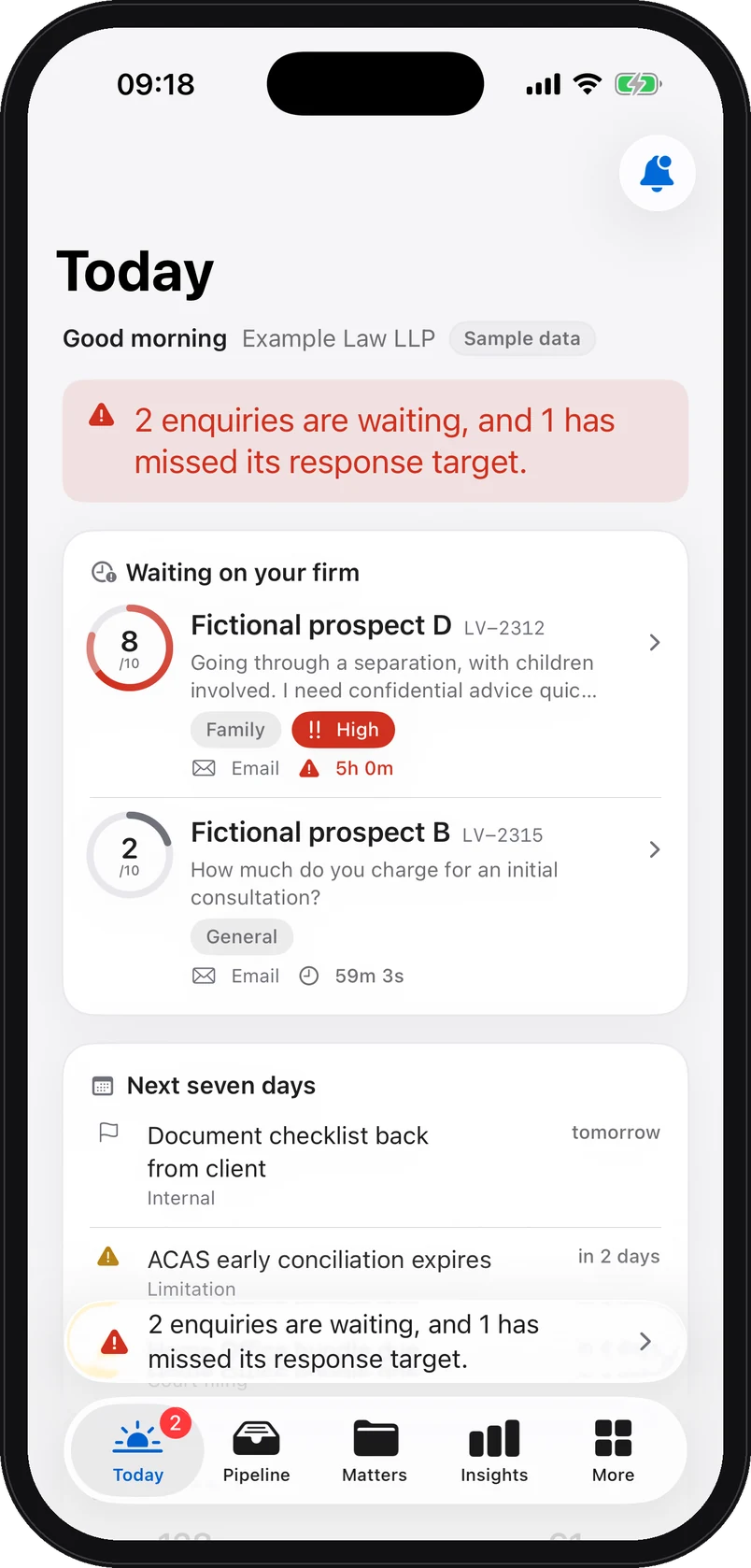
iPhone app screenshot with demo data: Today screen: two enquiries waiting on the fictional firm, the first a family-law enquiry from a fictional prospect scored 8 out of 10, high urgency, past its response target.

Web platform view and iPhone app screenshots. All demo data is fictional. The iPhone screen shows the sample data available, a family law enquiry; the enquiry above is a further example and the reading grid is the same in criminal work.

A week in a criminal law firm

Three situations you will recognise

Every enquiry arrives with an inquiry brief: summary, urgency, parties to check, missing information, documents to request. Here is what it would surface.

A hearing at the tribunal correctionnel

Fictional example: “I have received a summons to the tribunal correctionnel. The hearing is in three weeks and I have not spoken to anyone yet.”

Information to prepare for review
Human review
The lawyer checks the situation, urgency and applicable time limits.
Parties to check
The named civil party and any co-defendants.
Missing information
The court, date and type of summons. Any current judicial supervision measures.
Documents to discuss
The summons, any interview record provided and relevant personal circumstances.
A relative in police custody

Fictional example: “My brother was placed in police custody this morning. I am trying to find a lawyer for him.”

Information to prepare for review
Human review
The lawyer checks the situation, urgency and applicable time limits.
Parties to check
The person in custody and the identified complainant, if named.
Missing information
The investigating service, custody location and start time, any appointed lawyer, and the caller’s relationship to the person.
Documents to discuss
The service name and case reference, if known. Any notice provided to the family.

Reporting an assault

Fictional example: “I was assaulted on Friday after leaving work. I would like to make a complaint and have legal support.”

Information to prepare for review
Human review
The lawyer checks the situation, urgency and applicable time limits.
Parties to check
The person alleged to be responsible, if identified.
Missing information
The exact date and location, any complaint already filed, witnesses and recordings.
Documents to discuss
Medical certificate, complaint receipt if available, photographs and witness contact details.

Illustrative examples, fictional people. What a brief contains depends on the enquiry received. The brief summarises, scores and flags; it does not advise and it decides nothing. Someone at the firm assesses the merits and replies.

Demonstration

A demonstration on a fictional enquiry

The screens below are the product’s, on the demonstration firm’s sample data: Charlotte Bennett, a fictional person, writes at 22:47 about a separation. That enquiry is family law; the reading grid is the same in criminal work. It is structured within the minute, the acknowledgement goes out in the firm’s name at 22:49, and the brief waits for the lawyer on the platform and on their iPhone.

The enquiry brief

What the lawyer reads before deciding

The same grid at 2 pm and at 11 pm. Nothing is decided in their place.

  • Score 8 out of 10, hot, priority P1, with a rationale for the firm to review. Priority is an administrative indicator. An interview under caution that is about to start requires the firm’s urgent-contact procedure, without waiting for a standard response target.
  • Practice area, routing and next step. On the screen shown: family law, a suggested first contact, a confidential call. For a summons to the tribunal correctionnel, the proposed recipient would be the criminal-law team. A lawyer checks the hearing date and decides when to call back.
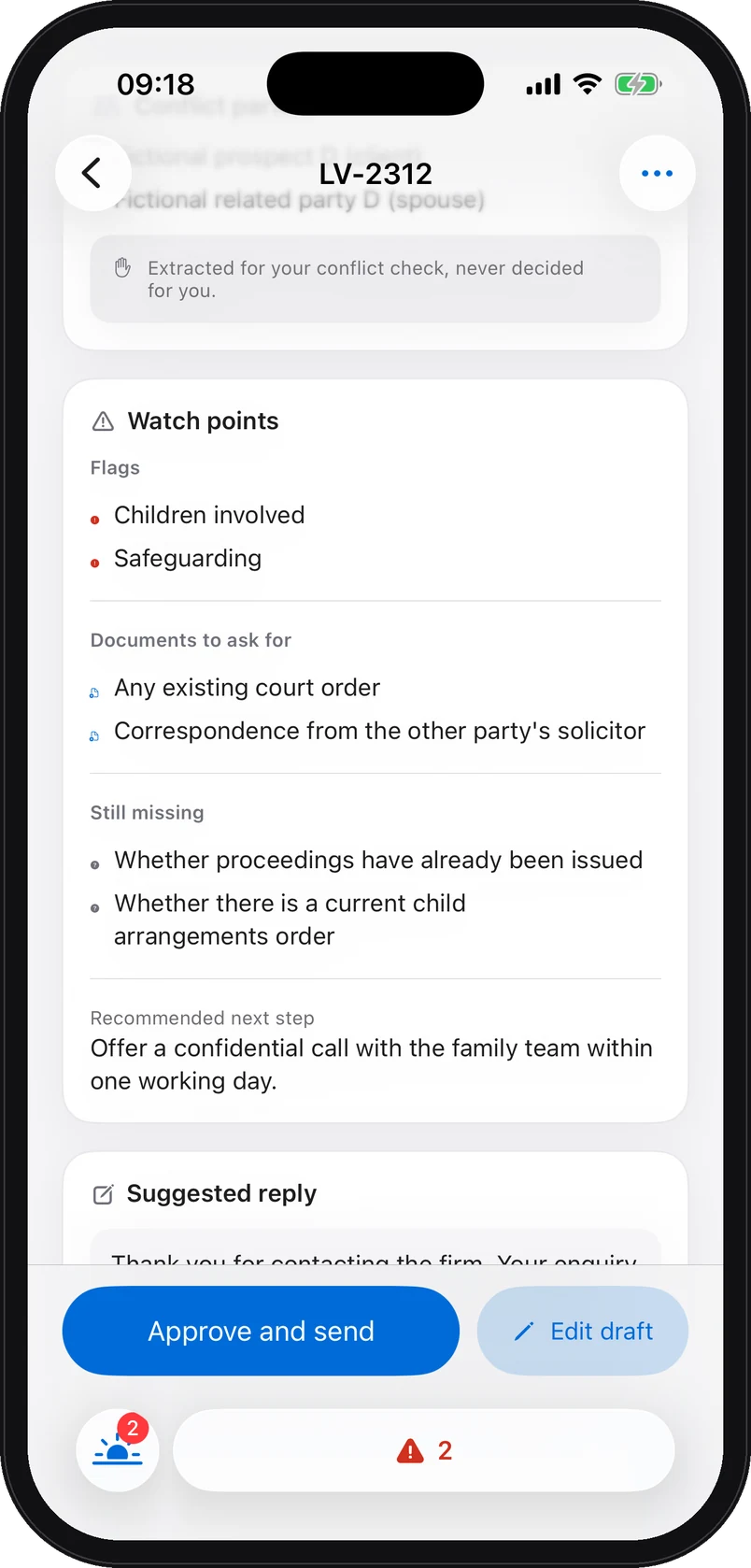
  • Needs attention. The screen flags children involved here. In criminal work it is a person in custody, a hearing date close at hand or bail conditions that surface in the same place.
  • Missing information and documents to request. What you need to know before the first call, and what the person should bring: on a summons, the document received, the court named on it and the hearing date.
  • Counterparties and conflict check. Names are extracted by the model and require human verification: in criminal work, the complainant and any co-defendants.

The person’s identifiers are replaced by tokens before any model call. Names are restored only inside your firm’s database.

iPhone app screenshot with demo data: The enquiry brief on iPhone: watch points, documents to ask for, missing information and the recommended next step, on a fictional family-law enquiry.
On the iPhone

The same brief, in the pocket of the lawyer on call

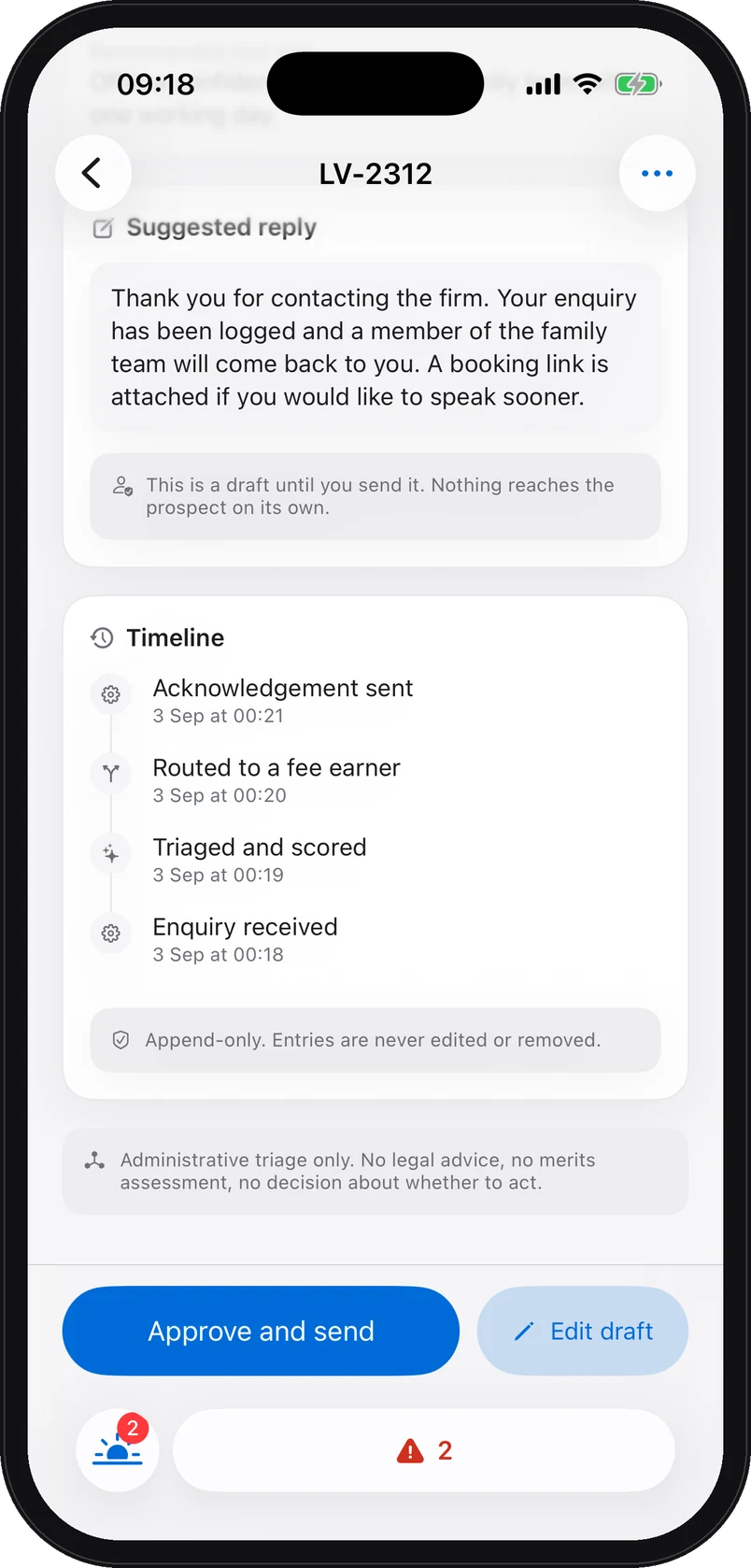
What is waiting, with its countdown. A suggested reply, marked as a draft. Two buttons: Approve and send, Edit draft.

  • A countdown on the lock screen, if the lawyer asks for it, and a reminder half an hour before the response target runs out. The reminder names a practice area and a score, never a client.
  • Draft replies for review The suggested reply only goes out if a lawyer approves or edits it. The only thing that leaves on its own is the acknowledgement, in wording approved at setup.
  • An append-only history: received, triaged and scored, routed to a fee earner, acknowledgement sent. Corrections add a new entry. Retention and deletion follow the applicable schedule.
  • Face ID locks the app as soon as it goes to the background.
iPhone app screenshot with demo data: The enquiry brief on iPhone: score 8 out of 10, a fictional prospect, family practice area, high urgency, summary, and the Approve and send, Edit draft buttons.
iPhone app screenshot with demo data: The suggested reply on iPhone, marked as a draft until it is sent, and the append-only timeline of the enquiry: received, triaged and scored, routed to a fee earner, acknowledgement sent.

Web platform view and iPhone app screenshots. All demo data is fictional.

Your figures

Compare fees and subscription costs

An illustrative calculation using the assumptions published for France.

Example for a firm of 3 to 9 lawyers
Incoming inquiries per month30
Assumed share missed or answered too late30%
Assumed conversion after timely handling25%
Assumed gross fees per matter€3,000
Annual Structure subscription, excluding VAT€13,800
Gross fee equivalent of the annual subscription5 matters

30 × 30% × 25% × 12 = 27 matters. 27 × €3,000 = €81,000 in gross fees.

These are assumptions, not measured results or a forecast of new matters. Replace them with your own figures. Setup fees, delivery costs and collection are excluded. Gross fees are not profit.

Before deciding

Use your own intake records

Review inquiries received, first-response times, follow-up owners and missing information. The pilot scope should address an observed need in your firm.

Security and confidentiality

Enquiries this personal, handled as such

Four controls you can verify, described without superlatives.

Pseudonymisation before model calls

Names, emails, phone numbers and other identifiers are replaced by tokens before an enquiry reaches a model. Encryption of the mapping depends on the deployment, as described on the security page.

Isolated per firm

Every client-data table carries a per-firm access rule, checked by automated tests on every change.

Documents sealed in the browser

Every document is encrypted before upload under two key exchanges, X25519 and ML-KEM-1024. Uploads are bounded, type-checked and content-inspected: embedded programs are refused.

Chained, signed audit trail

Sensitive actions are hash-linked and the head of the chain is signed daily with ML-DSA-87. The iPhone app verifies the signature on the device.

What we do not claim: no SOC 2 or ISO 27001 certification, and no external penetration test to date. Hosting on Supabase (EU, Ireland) and Vercel; the model is called through a server-side proxy, with no training on your data under OpenAI’s default policy.

Pricing

A flat fee for the whole firm

Criminal law is the included practice area. An additional area costs €295 per month. No per-user or per-inquiry charge. Setup costs €2,950 for Cabinet and Structure, or €3,950 for Association, including €600 at signature. The balance follows the No-Miss Guarantee terms. All prices exclude VAT.

Live in 7 days, a 60-day pilot then month to month, cancel any time, export your data any time. Read the guarantee in full.

Intake audit 15 minutes

See what this would change in your firm

Fifteen minutes with a founder. Your channels, your volume, your criminal law enquiries, and what happens in the evening and at the weekend. You leave with a costed estimate and a clear answer, including if it is not for you.

Prefer to write first? contact@lornevale.com